
Make room · Step 3
How to find 10 hours a week for a side business
Block fixed weekly slots, including one long one, give each week a single priority, and write a delivery line for the day a client signs. A 15-minute Monday check-in keeps the hours on the calendar.
Published November 27, 2026
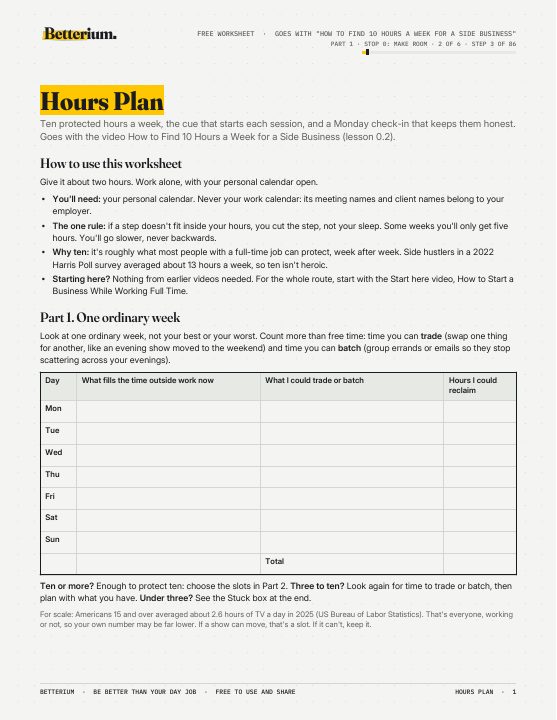
Get the Hours Plan
Ten protected hours a week, the cues that start each session, and a Monday check-in that tells you what to cut when a week gets squeezed
In short
- Fixed slots beat "whenever I get a chance." Put them on the calendar, including one long block.
- Give the week one priority, so every slot already knows its job.
- An if-then cue starts each slot, and a short Monday check-in keeps the plan honest.
Why ten hours?
Ten hours is enough to move a side business forward, as long as the hours are fixed in advance. It isn't heroic, either. A survey of American side hustlers by The Harris Poll found they put in about thirteen hours a week on average.1
Some weeks you'll only get five. That's fine. You'll go slower, never backwards. What doesn't work is "whenever I get a chance," because "whenever" doesn't exist on a calendar.
What are the three rules of the Hours Plan?
Fixed slots. Same time, same days, every week. You decide once and stop negotiating with yourself every evening. Make at least one slot long. Paul Graham nails this in "Maker's Schedule, Manager's Schedule": makers need half a day, because a single meeting can blow a whole afternoon.2 Put building work in your highest-energy slot and admin where your brain is already tired.
Dana, our example, gets her ten from a Saturday morning block, two early mornings, Sunday afternoon and one evening for admin.3 All outside work hours, on her own laptop.
One priority a week. An empty slot is how you spend ninety minutes reorganizing your desktop and call it strategy. On this route, the priority is usually just the next lesson. If a step needs more hours than you have, shrink the step. Two priorities is a wish list. Three is a LinkedIn post.
A delivery line. One day someone will pay you, and delivery will try to eat all ten hours. So write one line now that says which slots delivery takes first and what waits. Dana's: "When a client signs, delivery gets Saturday and both early mornings. Everything else waits for what's left." She still has ten hours, not fifteen.
How do you make a slot actually start?
Give it an if-then cue. Psychologists call it an implementation intention: if a specific situation comes up, I'll do a specific thing.4 A review of ninety-four tests found if-then plans made a clear difference to whether people followed through on their goals.5
Dana's Tuesday cue: "If it's 6:15 on Tuesday, then I open the laptop at the kitchen table before I open my phone." Write one for bad weeks too: "If Saturday's block gets taken, then I move it to Sunday morning."
What is the Monday check-in?
A fifteen-minute repeating slot that comes out of your ten hours, not on top of them. Look at three things: how many hours happened last week, this week's one priority, and whether a slot needs to move before the week moves it for you. If the hours keep coming up short, cut the step. Never just add hours.
Can AI help you find the hours?
Use your personal calendar only, never your work one. Share one ordinary week with anything private renamed "busy," plus your working hours. Ask for about ten reclaimable hours, one long block, and an if-then cue for each. AI drafts, you decide.
Try it this week
Block fixed weekly slots, choose one priority a week, and add a delivery line for when a client signs. It takes about two hours. The free Hours Plan worksheet walks you through it, from a one-week time audit to your weekly review.
Put this lesson to work with the Hours Plan
Questions people ask
What if I can't find ten hours anywhere?
You're probably counting only free time. Look for time you can trade, like a show that moves to the weekend, or batch, like errands. If you're still short, block three real hours and shrink every step to fit.
When should I pause?
If you're under three hours for four weeks running, pause the route and put a restart date on the calendar. Pausing on purpose is a decision. Drifting isn't.
What if my household needs a say in these hours?
They should. How to Balance a Side Business and Family (coming soon) helps you agree the hours with the people you live with.
Next on the route: How to Balance a Side Business and Family. Coming soon. Get the roadmap to hear when it’s out.
← Previous step: Can your employer own your side business idea?
- The Harris Poll for Zapier, side hustle report (Zapier blog), 2022: side hustlers average 13.4 hours a week. Fielded 24 to 26 May 2022 with 2,032 US adults, 799 of them with a side hustle. ↩
- Paul Graham, "Maker's Schedule, Manager's Schedule", paulgraham.com, July 2009. ↩
- Dana is our example, not a real person. ↩
- National Cancer Institute, Behavioral Research Program, "Implementation Intentions" (construct page by Gollwitzer and Sheeran). ↩
- Peter M. Gollwitzer and Paschal Sheeran, "Implementation intentions and goal achievement: a meta-analysis of effects and processes", Advances in Experimental Social Psychology 38, 2006: 94 independent tests, with a medium-to-large effect on goal attainment (d = .65). ↩